


US Spot BTC ETFs recorded net outflows of $60.4 million in a single trading session, marking a notable departure from the optimistic sentiment that characterised earlier months. While Bitcoin exchange-traded funds struggle to maintain investor confidence, altcoin markets are experiencing renewed interest with capital flowing into alternative digital assets. This divergence signals a potential rotation in crypto investment strategies as traders and institutional investors reassess their portfolio allocations. The outflows from US Spot BTC ETFs come at a critical juncture when Bitcoin’s price action has shown signs of consolidation, prompting market participants to explore opportunities beyond the flagship cryptocurrency.
Current US Spot BTC ETFs Landscape
The emergence of US Spot BTC ETFs in early 2024 marked a watershed moment for cryptocurrency adoption in traditional finance. These investment vehicles, approved by the Securities and Exchange Commission, provided institutional and retail investors with regulated exposure to Bitcoin without the complexities of direct cryptocurrency ownership. Major financial institutions, including BlackRock, Fidelity, and Grayscale, launched their respective Bitcoin ETF products, collectively attracting billions in assets under management during the initial enthusiasm.
However, the recent $60.4 million outflow represents a concerning trend that has developed over consecutive trading sessions. This withdrawal of capital suggests that investors are either taking profits after substantial gains or repositioning their portfolios based on evolving market dynamics. The US Spot BTC ETFs sector, which once commanded unwavering attention from Wall Street, now faces questions about sustainability and long-term growth prospects.
Factors Behind the Bitcoin ETF Outflows
Several interconnected factors have contributed to the capital flight from US Spot BTC ETFs:
Market Maturation and Profit-Taking: After Bitcoin’s impressive rally that saw prices climb above $70,000, many early ETF investors have chosen to lock in gains. The profit-taking behaviour is particularly pronounced among institutional investors who entered positions during the initial launch phase.
Macroeconomic Pressures: Rising interest rates and persistent inflation concerns have prompted investors to reassess risk assets across the board. Bitcoin, despite its reputation as “digital gold,” has not been immune to broader market pressures affecting equities and cryptocurrencies alike.
Competition from Traditional Assets: As bond yields have become more attractive, some capital that flowed into Bitcoin ETFs has rotated back into fixed-income securities, offering more predictable returns with lower volatility.
Technical Resistance Levels: Bitcoin’s struggle to break through key psychological and technical resistance levels has created uncertainty among momentum traders who comprise a significant portion of ETF investors.
The Altcoin Capital Flow Revolution
While US Spot BTC ETFs experience redemptions, the altcoin market is witnessing a remarkable resurgence in capital inflows. This phenomenon, often referred to as “alt season” in cryptocurrency circles, occurs when investors diversify beyond Bitcoin to capture potentially higher returns from alternative cryptocurrencies.
Which Altcoins Are Attracting Capital?
The capital migration has benefited several categories of altcoins:
Ethereum and Layer-1 Blockchains: Ethereum continues to attract substantial investment due to its dominance in decentralised finance (DeFi) and non-fungible tokens (NFTs). Competing layer-1 blockchains like Solana, Avalanche, and Cardano have also seen increased trading volumes and institutional interest.
DeFi Tokens: Decentralised finance protocols are experiencing renewed attention as yield farming opportunities and protocol innovations attract both retail and institutional capital. Tokens associated with lending platforms, decentralised exchanges, and liquidity protocols have posted impressive gains.
AI and Technology-Focused Cryptocurrencies: The artificial intelligence boom has created spillover effects in the crypto market, with AI-related tokens and blockchain projects integrating machine learning capabilities, seeing significant capital inflows.
Real-World Asset (RWA) Tokenisation Projects: Platforms facilitating the tokenisation of traditional assets like real estate, commodities, and securities have gained traction as bridges between traditional and decentralised finance.
The Rotation Strategy
The shift from Bitcoin ETFs to altcoins represents a calculated risk-reward assessment by sophisticated investors. When Bitcoin’s price stabilises or enters consolidation phases, historically, altcoins have offered superior short-term returns due to their higher volatility and smaller market capitalisations. This rotation strategy, while potentially lucrative, carries substantially greater risk compared to Bitcoin-focused investments.
Traders employing this strategy typically monitor Bitcoin dominance—the percentage of total cryptocurrency market capitalisation represented by Bitcoin. When dominance declines, it signals capital flowing into alternative cryptocurrencies, creating opportunities for those positioned in altcoin markets.
Impact of US Spot BTC ETFs Outflows on Bitcoin Price
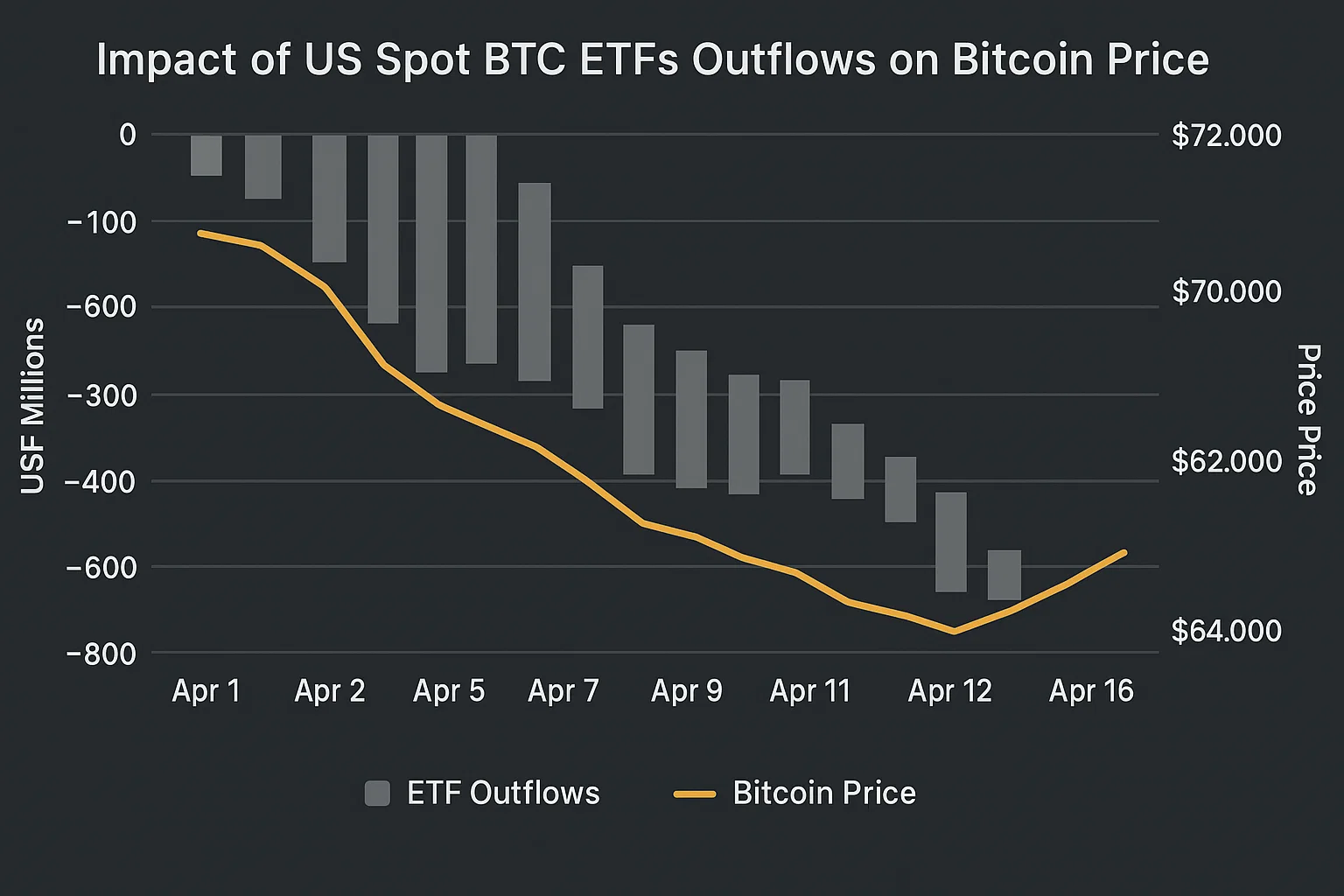
The relationship between ETF flows and Bitcoin’s spot price is complex and multifaceted. While $60.4 million represents a relatively small percentage of Bitcoin’s daily trading volume, which often exceeds $30 billion, the psychological impact and signal these outflows send to the broader market cannot be understated.
Short-Term Price Pressure
ETF outflows create selling pressure as fund managers must liquidate Bitcoin holdings to meet redemption requests. This mechanistic selling, regardless of market conditions or technical levels, can exacerbate downward price movements, particularly during periods of low liquidity or negative sentiment.
Long-Term Implications for Institutional Adoption
The more significant concern for Bitcoin advocates is whether sustained outflows from US Spot BTC ETFs indicate waning institutional interest in the asset class. The approval of these ETFs was celebrated as a validation of Bitcoin’s legitimacy within traditional finance. Persistent capital outflows could undermine this narrative and delay broader institutional adoption.
However, market analysts caution against overinterpreting short-term flow data. Historical patterns in commodity and equity ETFs demonstrate that outflows often occur during consolidation periods and don’t necessarily predict long-term trajectory. Bitcoin’s fundamental value proposition—scarcity, decentralisation, and censorship resistance—remains unchanged regardless of temporary ETF dynamics.
Comparing Bitcoin ETFs to Traditional Investment Vehicles
To contextualise the $60.4 million outflow from US Spot BTC ETFs, it’s instructive to compare cryptocurrency ETF behaviour with traditional investment vehicles:
Volatility and Flow Patterns
Traditional equity and commodity ETFs typically experience more stable flow patterns, with outflows occurring primarily during bear markets or significant sector rotations. Cryptocurrency ETFs, by contrast, exhibit higher volatility in both asset prices and fund flows, reflecting the nascent and speculative nature of digital asset markets.
Investor Demographics
US Spot BTC ETFs attract a diverse investor base ranging from retail traders seeking convenient exposure to institutional investors incorporating digital assets into diversified portfolios. This heterogeneity creates unpredictable flow patterns as different investor types respond to market conditions based on varying time horizons and risk tolerances.
Fee Structures and Competition
The competitive landscape among Bitcoin ETF providers has led to fee compression, with expense ratios ranging from 0.20% to 0.95%. Lower fees benefit investors but pressure fund managers to differentiate through services, educational resources, or ancillary benefits. Grayscale’s higher-fee structure, a legacy of its previous trust format, has contributed to significant outflows as investors migrate to lower-cost alternatives.
Regulatory Environment and Its Effect on US Spot BTC ETFs
The regulatory framework governing US Spot BTC ETFs continues to evolve, creating both opportunities and challenges for the sector:
SEC Oversight and Compliance
The Securities and Exchange Commission’s approval of spot Bitcoin ETFs came with stringent operational requirements, including surveillance-sharing agreements, custody standards, and reporting obligations. These regulatory safeguards provide investor protection but also create operational overhead that impacts fund economics.
Potential for Additional Crypto ETF Products
The success of Bitcoin ETFs, despite recent outflows, has paved the way for applications seeking approval for other cryptocurrency ETF products. Ethereum ETF applications are currently under regulatory review, and approval would likely trigger another wave of institutional capital into crypto markets, potentially affecting Bitcoin ETF flows as investors diversify across multiple digital asset ETFs.
Global Regulatory Developments
International regulatory approaches to cryptocurrency ETFs vary significantly. Canada and Europe have operated crypto ETF products for years, while Asian markets are developing their own frameworks. Harmonisation of global regulations could facilitate cross-border capital flows and reduce regulatory arbitrage, benefiting the overall crypto ETF ecosystem.
Technical Analysis: Bitcoin Price Action Amid ETF Outflows
From a technical perspective, Bitcoin’s price behaviour during the period of US Spot BTC ETF outflows reveals important market structure:
Support and Resistance Levels
Bitcoin has established key support around the $65,000-$67,000 range, which has held despite ETF redemptions. Resistance remains formidable at $72,000-$73,000, representing previous all-time highs. The consolidation between these levels suggests market equilibrium, where neither bulls nor bears have definitive control.
Volume Profile and Liquidity
On-chain analytics indicate that while ETF flows have turned negative, spot exchange volumes remain healthy, suggesting that direct cryptocurrency purchases and peer-to-peer transactions continue supporting price discovery. Derivative markets show balanced positioning with funding rates near neutral, indicating the absence of extreme leverage in either direction.
Correlation with Traditional Markets
Bitcoin’s correlation with technology stocks and the broader equity market has strengthened during this period, suggesting that macro factors rather than crypto-specific dynamics are driving short-term price action. This correlation implies that US Spot BTC ETFs outflows may partially reflect broader risk-off sentiment rather than Bitcoin-specific concerns.
Institutional Investment Strategies Beyond Bitcoin ETFs

Sophisticated institutional investors are exploring diverse strategies for cryptocurrency exposure beyond US Spot BTC ETFs:
Direct Custody Solutions
Major corporations and financial institutions are increasingly establishing direct custody relationships with qualified digital asset custodians, bypassing ETF structures entirely. This approach offers greater flexibility in portfolio construction, access to staking rewards, and participation in governance mechanisms unavailable through ETF investments.
Venture Capital and Equity Investments
Rather than purchasing cryptocurrency directly, some institutions are gaining exposure through equity investments in blockchain companies, cryptocurrency exchanges, and infrastructure providers. This strategy captures potential upside from crypto adoption while avoiding direct exposure to cryptocurrency price volatility.
Structured Products and Derivatives
The maturation of cryptocurrency derivatives markets has enabled institutions to construct sophisticated exposure through options, futures, and structured notes. These instruments offer customised risk-return profiles and hedging capabilities not available through simple ETF ownership.
Future Outlook for US Spot BTC ETFs
Despite recent outflows, the long-term outlook for US Spot BTC ETFs remains cautiously optimistic based on several factors:
Growing Awareness and Accessibility
As awareness of Bitcoin and cryptocurrency investment opportunities spreads among traditional investors, ETFs remain the most accessible entry point for those uncomfortable with direct cryptocurrency ownership, private key management, or exchange accounts.
Generational Wealth Transfer
The ongoing transfer of wealth to younger generations who exhibit greater comfort with digital assets and technology-driven investments suggests a natural expanding investor base for Bitcoin ETFs over the coming decades.
Portfolio Diversification Benefits
Academic research increasingly supports the inclusion of small Bitcoin allocations in diversified portfolios for their non-correlated returns and potential inflation hedge characteristics. This evolving understanding could drive steady institutional accumulation through ETF vehicles.
Product Innovation and Expansion
ETF issuers are developing enhanced products, including actively managed Bitcoin funds, Bitcoin income strategies utilising covered calls, and multi-cryptocurrency baskets that could attract different investor segments and reignite inflows.
Risk Factors Investors Should Consider
Participants in US Spot BTC ETFs must carefully evaluate several risk dimensions:
Cryptocurrency Market Volatility
Bitcoin’s historical price volatility far exceeds traditional asset classes, with drawdowns of 50% or more occurring during bear markets. ETF investors must possess appropriate risk tolerance and time horizons to weather such volatility.
Regulatory and Legal Risks
Changes in cryptocurrency regulation, tax treatment, or legal classification could materially impact Bitcoin’s value proposition and ETF structures. Investors should monitor regulatory developments and understand potential implications for their holdings.
Technological and Security Risks
Despite robust custody solutions, cryptocurrency investments face unique technological risks, including network vulnerabilities, smart contract exploits, and potential quantum computing threats to cryptographic security. ETF structures mitigate some individual risks but don’t eliminate systemic technological concerns.
Market Manipulation Concerns
Cryptocurrency markets, while maturing, remain more susceptible to manipulation than heavily regulated traditional markets. Large holders (“whales”) can influence prices through coordinated buying or selling, creating risks for passive ETF investors.
Comparing Bitcoin ETF Performance Across Providers
The competitive landscape of US Spot BTC ETFs has created performance differentials based on several factors:
Expense Ratios and Fee Impact
Lower expense ratios directly benefit long-term returns through reduced cost drag. A difference of 0.50% annually may seem minor, but it compounds significantly over investment horizons of five or ten years.
Trading Liquidity and Spreads
ETFs with higher trading volumes typically offer tighter bid-ask spreads, reducing implicit transaction costs for investors. Market makers provide more competitive pricing for high-volume funds, benefiting both buyers and sellers.
Tracking Accuracy
While all Bitcoin ETFs track the same underlying asset, differences in execution, custody arrangements, and operational efficiency create slight tracking variations. Investors seeking to maximise returns should evaluate historical tracking accuracy alongside fee structures.
The Role of Media and Sentiment in ETF Flows
Public perception and media coverage significantly influence US Spot BTC ETFs flows:
Narrative Cycles
Cryptocurrency markets are particularly susceptible to narrative-driven cycles. Positive stories about institutional adoption, technological breakthroughs, or regulatory clarity can trigger inflows, while negative coverage of hacks, regulations, or price declines precipitate outflows.
Social Media Influence
Twitter, Reddit, and other social platforms amplify both bullish and bearish sentiment, creating feedback loops that accelerate capital flows in either direction. The decentralised, always-on nature of cryptocurrency communities ensures continuous commentary that influences investor behaviour.
Financial Media Coverage
Mainstream financial media’s treatment of Bitcoin has evolved from scepticism to cautious acceptance. Balanced coverage that acknowledges both opportunities and risks helps temper excessive speculation while educating potential investors about appropriate position sizing and risk management.
Strategic Considerations for Individual Investors
For individual investors considering US Spot BTC ETFs amid current market conditions:
Dollar-Cost Averaging Approach
Rather than attempting to time entries and exits, systematic accumulation through regular purchases can smooth volatility and remove emotional decision-making from the investment process. This strategy has proven effective for long-term Bitcoin investors historically.
Portfolio Allocation Guidelines
Financial advisors generally recommend limiting cryptocurrency exposure to 1-5% of total portfolio value, depending on individual risk tolerance, investment timeline, and financial goals. This sizing ensures meaningful participation in potential upside while limiting downside impact on overall wealth.
Tax Optimisation Strategies
Understanding tax implications of ETF transactions, including wash sale rules, capital gains treatment, and retirement account considerations, can significantly impact after-tax returns. Consultation with tax professionals familiar with cryptocurrency investments is advisable.
Rebalancing Discipline
Establishing and maintaining target allocations through periodic rebalancing prevents cryptocurrency positions from becoming disproportionately large during bull markets or diminishing to irrelevance during bear markets. This discipline enforces the profitable behaviour of buying low and selling high.
Conclusion
The $60.4 million outflow from US Spot BTC ETFs represents a meaningful data point in the ongoing evolution of cryptocurrency investment vehicles, but should be contextualised within broader market dynamics. While capital rotates into altcoins seeking higher returns, Bitcoin’s fundamental value proposition as digital gold and a portfolio diversification tool remains intact. The temporary nature of ETF outflows during consolidation periods has historical precedent in traditional markets and doesn’t necessarily predict the long-term trajectory.
Investors must approach US Spot BTC ETFs with realistic expectations, appropriate risk management, and an understanding of cryptocurrency market dynamics. The approved ETF structures provide regulated, accessible exposure to Bitcoin while mitigating individual custody and security risks. Whether current outflows represent a temporary rotation or signal deeper concerns will become clear through continued monitoring of fund flows, Bitcoin’s price action, and broader macroeconomic conditions.
Read More: Top Crypto News Sources for Day Trading 2025