


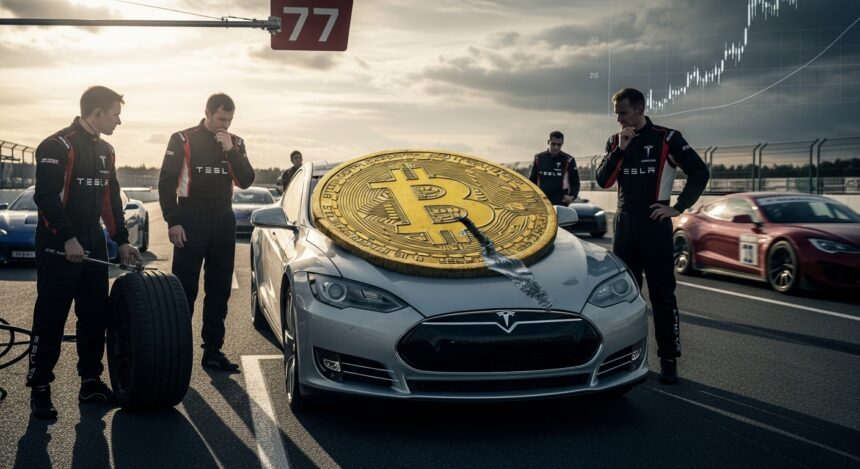
This moment highlights more than short-term price action. It reveals how Tesla views Bitcoin as part of a long-term strategic vision rather than a speculative trad I a financial landscape where corporate crypto adoption remains cautious, Tesla’s decision to hold sends a strong signal to investors, institutions, and the wider market about confidence in cryptocurrency, digital assets, and alternative stores of value.
Tesla’s Bitcoin Bet Hits a Speed Bump in a Volatile Market
When Tesla’s Bitcoin bet hits a speed bump, it reflects the inherent volatility of the cryptocurrency market rather than a fundamental shift in Tesla’s outlook. Bitcoin’s price cycles are well known, driven by macroeconomic pressures, interest rate expectations, regulatory headlines, and shifts in investor sentiment.
Tesla’s balance sheet exposure means that price dips translate into accounting headwinds, particularly under rules that require companies to record impairment losses during downturns. These paper losses can appear alarming, but they do not necessarily represent realized damage unless the asset is sold. Tesla’s decision to hold through volatility suggests confidence in Bitcoin’s long-term value proposition. This stance differentiates Tesla from companies that treat crypto as a short-term hedge or speculative instrument. Instead, Tesla appears to see Bitcoin as a strategic asset aligned with its broader innovation-driven identity.
Why Tesla Is Holding Bitcoin Despite the Speed Bump
Long-Term Conviction Over Short-Term Noise
The fact that Tesla is not selling despite the slowdown underscores a philosophy rooted in long-term conviction. Bitcoin’s scarcity, decentralized structure, and growing institutional acceptance continue to attract corporations seeking diversification beyond traditional cash reserves.
When Tesla’s Bitcoin bet hits a speed bump, the company’s response suggests patience rather than panic. This approach mirrors Tesla’s broader corporate behavior, where short-term challenges are often absorbed in pursuit of long-term dominance in electric vehicles, energy storage, and autonomous technology.
Balance Sheet Strategy and Inflation Hedging
Tesla’s Bitcoin position has often been viewed as a hedge against currency debasement and inflation. While Bitcoin’s short-term performance can diverge from this narrative, its fixed supply remains attractive to companies managing large cash balances. Holding Bitcoin also signals a willingness to experiment with non-traditional treasury strategies, a move that aligns with Tesla’s reputation as a disruptor rather than a conservative incumbent.
The Accounting Reality Behind Tesla’s Bitcoin Holdings
One reason headlines intensify when Tesla’s Bitcoin bet hits a speed bump is the accounting treatment of digital assets. Current accounting standards require companies to mark down the value of Bitcoin when prices fall, but they do not allow upward revaluation unless the asset is sold.
This creates an asymmetry where losses appear on financial statements while gains remain unrealized on paper. For Tesla, this means quarterly results can reflect impairment charges even if Bitcoin later recovers. Investors who understand this nuance tend to focus less on short-term accounting impacts and more on Tesla’s underlying operational performance and strategic positioning.
Market Reaction and Investor Sentiment
How Wall Street Interprets Tesla’s Crypto Exposure
Wall Street’s reaction to Tesla’s Bitcoin exposure has evolved over time. Initially, the move was seen as bold and unconventional. As the crypto market matured, investors began to view it as a calculated risk rather than a reckless gamble.
When Tesla’s Bitcoin bet hits a speed bump, market reactions often hinge on broader sentiment toward technology stocks, interest rates, and risk assets. During periods of risk aversion, crypto exposure can amplify concerns. During bullish cycles, the same exposure is seen as visionary.
Retail Investors and the Bitcoin Narrative
Retail investors closely watch Tesla’s crypto decisions, often viewing them as a proxy for mainstream adoption. Tesla’s refusal to sell reinforces confidence among Bitcoin proponents who see corporate holding as validation of Bitcoin’s legitimacy. This dynamic illustrates how Tesla’s actions extend beyond its balance sheet, influencing narratives across equity and crypto markets alike.
Tesla, Bitcoin, and the Broader Crypto Economy
Corporate Adoption of Cryptocurrency
Tesla’s Bitcoin investment played a pivotal role in accelerating corporate interest in cryptocurrency. While adoption has slowed amid regulatory scrutiny and market corrections, Tesla remains one of the most visible examples of a major corporation holding Bitcoin.

When Tesla’s Bitcoin bet hits a speed bump, it tests the resilience of this adoption trend. So far, Tesla’s commitment suggests that corporate crypto strategies are evolving rather than disappearing.
Regulatory Environment and Risk Management
Regulatory uncertainty continues to shape how companies approach Bitcoin. Tesla’s ability to navigate this environment without exiting its position suggests confidence in its compliance framework and risk management practices. This approach may encourage other corporations to revisit crypto strategies with a more measured, long-term mindset.
Elon Musk’s Influence on Tesla’s Bitcoin Strategy
Elon Musk’s public comments have historically influenced both Tesla’s stock and the crypto market. While Tesla’s Bitcoin decisions are ultimately corporate actions, Musk’s broader enthusiasm for technological disruption frames how these moves are perceived. When Tesla’s Bitcoin bet hits a speed bump, Musk’s relative silence or measured commentary often helps stabilize market interpretation. This restraint contrasts with earlier periods of vocal crypto engagement and reflects a more mature approach to corporate asset management.
Bitcoin Volatility and Its Impact on Tesla Stock
Bitcoin volatility does not exist in isolation. It interacts with Tesla’s stock performance, sometimes amplifying price movements. However, over time, the correlation between Tesla shares and Bitcoin prices has weakened as investors refocus on core fundamentals like vehicle deliveries, margins, and energy growth. Understanding this separation is key to evaluating Tesla objectively. Bitcoin is a component of Tesla’s financial story, but it is not the defining factor.
What Tesla’s Decision Signals to the Market
Tesla’s refusal to sell during downturns sends a message of resilience and strategic patience. It suggests that Bitcoin is not a speculative side bet but a calculated component of Tesla’s broader vision. When Tesla’s Bitcoin bet hits a speed bump, the company’s steady response reinforces its identity as a long-term thinker willing to withstand volatility in pursuit of transformative outcomes.
Conclusion
In moments when Tesla’s Bitcoin bet hits a speed bump, it becomes easy to focus on short-term losses and market noise. Yet Tesla’s decision to hold rather than sell reveals a deeper belief in innovation, diversification, and long-term value creation.
For investors, analysts, and crypto observers, this stance offers a valuable lesson in conviction-driven strategy. If you want to understand how corporate giants navigate digital assets amid uncertainty, keep watching how Tesla’s Bitcoin bet hits a speed bump and how the company responds. The story is far from over, and its implications extend well beyond Tesla itself.