


As the second-largest cryptocurrency by market capitalization struggles to break through key resistance levels, savvy crypto enthusiasts are actively exploring Ethereum alternatives that promise higher returns and innovative technological features. This shift in investor sentiment isn’t driven by disillusionment with Ethereum’s fundamentals, but rather by the recognition that the crypto ecosystem has evolved to offer numerous compelling alternatives. With Ethereum alternatives gaining traction across DeFi, NFTs, and Layer-2 scaling solutions, understanding which projects deserve attention has become crucial for investors seeking to maximize their portfolio performance in 2025.
Ethereum’s Current Market Position
Why ETH Is Trading Sideways
Ethereum’s sideways movement has become a defining characteristic of its recent price action, frustrating traders who anticipated bullish momentum following major network upgrades. Several factors contribute to this consolidation phase. The macroeconomic environment, including regulatory uncertainty and institutional hesitation, has created headwinds for all cryptocurrencies, but Ethereum faces unique challenges. Network congestion during peak usage periods continues to drive gas fees higher, making transactions prohibitively expensive for average users. This has pushed developers and users alike to explore alternative cryptocurrencies that offer similar functionality at a fraction of the cost.
The transition to proof-of-stake, while technologically impressive, hasn’t delivered the price appreciation many investors expected. Competition from faster, more scalable blockchain platforms has intensified, with several Ethereum alternatives demonstrating superior transaction throughput and lower fees. Additionally, the broader market sentiment has shifted toward projects offering immediate utility and innovative tokenomics rather than established players with mature ecosystems.
Market Sentiment and Investor Behavior
Current market sentiment reveals a growing appetite for diversification beyond Bitcoin and Ethereum. Data from blockchain analytics platforms shows significant capital rotation from ETH into emerging altcoins with strong fundamentals and growth potential. Investors are increasingly sophisticated, conducting thorough research into tokenomics, development activity, and real-world adoption metrics before committing capital.
The psychology driving this shift centers on opportunity cost. When a major asset like Ethereum trades sideways for extended periods, active traders naturally seek crypto investments that can deliver superior short-to-medium term returns. This doesn’t necessarily indicate lost faith in Ethereum’s long-term vision, but rather a pragmatic approach to capital allocation in a market filled with innovative alternatives.
Top Ethereum Alternatives Gaining Momentum
Solana (SOL): The Speed Champion
Solana has emerged as one of the most prominent Ethereum alternatives, offering blazing-fast transaction speeds and remarkably low fees. Capable of processing over 65,000 transactions per second, Solana’s performance metrics dwarf Ethereum’s current capabilities. The network’s proof-of-history consensus mechanism, combined with proof-of-stake, creates a unique architecture that prioritizes speed without sacrificing security.
The Solana ecosystem has experienced explosive growth, attracting major DeFi protocols, NFT marketplaces, and Web3 applications. Projects like Magic Eden, Jupiter, and Marinade Finance have demonstrated that smart contract platforms beyond Ethereum can cultivate vibrant, sustainable ecosystems. For investors seeking Ethereum alternatives, Solana offers exposure to a mature yet rapidly growing network with strong developer support and institutional backing.
However, Solana’s history of network outages has raised questions about reliability. The development team has addressed these concerns through continuous improvements, and recent uptime statistics show significant progress. For risk-tolerant investors, Solana represents a compelling alternative with substantial upside potential.
Cardano (ADA): The Academic Approach
Cardano distinguishes itself among blockchain alternatives through its research-driven development philosophy. Founded by Ethereum co-founder Charles Hoskinson, Cardano emphasizes peer-reviewed research and formal verification methods to ensure code correctness and security. This methodical approach has resulted in slower development cycles compared to competitors, but the network’s stability and security profile are impressive.
The Cardano ecosystem has matured considerably, with dozens of DeFi protocols, NFT projects, and enterprise solutions now operating on the platform. The recent implementation of smart contract capabilities through the Alonzo upgrade has unlocked new possibilities for developers. Cardano’s focus on sustainability, interoperability, and scalability positions it as a thoughtful Ethereum alternative for long-term investors who value robust fundamentals over hype-driven price action.
Cardano’s treasury system and on-chain governance mechanisms ensure sustainable funding for development while giving the community meaningful input into the network’s evolution. These features make Cardano particularly attractive to investors seeking alternative cryptocurrencies with proven longevity and clear roadmaps.
Avalanche (AVAX): The Subnet Innovator
Avalanche has carved out a unique niche among Ethereum alternatives through its innovative subnet architecture, which allows developers to create custom blockchain networks with specific rules and validators. This flexibility enables unprecedented levels of customization while maintaining interoperability with the broader Avalanche ecosystem. The platform’s consensus mechanism delivers sub-second finality, making it ideal for applications requiring instant transaction confirmation.
The Avalanche ecosystem has attracted significant attention from traditional finance institutions exploring blockchain integration. Partnerships with major financial entities and the successful implementation of tokenized assets demonstrate Avalanche’s real-world utility. For investors evaluating crypto investments, Avalanche offers exposure to institutional adoption trends alongside retail-driven growth in DeFi and gaming applications.
Avalanche’s three-chain architecture separates transaction processing, smart contract execution, and governance operations, optimizing performance for each function. This thoughtful design philosophy exemplifies the innovation driving new smart contract platforms that challenge Ethereum’s dominance.
Polygon (MATIC): The Scaling Solution
Polygon occupies a unique position among Ethereum alternatives by functioning as both a Layer-2 scaling solution and a standalone sidechain ecosystem. This dual nature allows Polygon to leverage Ethereum’s security while offering dramatically improved performance and lower costs. Major brands, including Nike, Starbucks, and Disney, have chosen Polygon for their Web3 initiatives, validating the platform’s enterprise readiness.
The Polygon ecosystem encompasses multiple scaling technologies, including Polygon PoS, Polygon zkEVM, and Polygon Supernets. This diversified approach ensures developers can choose the optimal solution for their specific requirements. For investors, Polygon represents a strategic way to maintain exposure to Ethereum’s ecosystem while benefiting from innovation in blockchain alternatives that solve Ethereum’s most pressing challenges.
Polygon’s partnerships with traditional enterprises and its role in mainstream blockchain adoption make it particularly appealing for conservative investors seeking crypto investments with demonstrated real-world traction. The platform’s commitment to zero-knowledge proof technology positions it at the forefront of scalability innovation.
Emerging Ethereum Alternatives to Watch

Sui: The Next-Generation Smart Contract Platform
Sui represents a new generation of smart contract platforms built from the ground up to address limitations in existing blockchains. Developed by former Meta engineers who worked on the Diem project, Sui employs the Move programming language, which offers superior safety and expressiveness compared to Solidity. The network’s object-centric data model and parallel transaction processing enable unprecedented scalability and performance.
Early adoption metrics for Sui have been impressive, with DeFi protocols and gaming applications demonstrating the platform’s capabilities. For investors seeking exposure to cutting-edge Ethereum alternatives, Sui offers the potential for significant appreciation as the ecosystem matures. The project’s strong technical team and innovative architecture make it a compelling long-term holding.
Aptos: The Parallel Processing Pioneer
Aptos, another Move-based blockchain developed by former Diem engineers, focuses on parallel transaction execution and user safety. The network’s Block-STM consensus mechanism processes transactions optimistically in parallel, dramatically increasing throughput. This technical innovation addresses one of Ethereum’s most significant bottlenecks, making Aptos an attractive Ethereum alternative for developers building high-performance applications.
The Aptos ecosystem has grown rapidly, attracting major DeFi protocols, NFT marketplaces, and gaming platforms. The network’s emphasis on user experience, including human-readable transaction previews and account recovery options, differentiates it from competitors. For investors evaluating alternative cryptocurrencies, Aptos represents a high-risk, high-reward opportunity with substantial technological advantages.
Arbitrum: The Optimistic Rollup Leader
Arbitrum leads the Layer-2 scaling solution category, offering Ethereum-compatible smart contracts with dramatically reduced fees and faster confirmation times. As an optimistic rollup, Arbitrum inherits Ethereum’s security guarantees while processing transactions off-chain for improved efficiency. The platform’s seamless compatibility with Ethereum tooling has made it the preferred choice for many developers migrating from Ethereum’s mainnet.
The Arbitrum ecosystem has experienced explosive growth, with total value locked exceeding billions of dollars across hundreds of protocols. For investors seeking Ethereum alternatives that maintain close ties to the Ethereum ecosystem, Arbitrum offers an ideal balance between innovation and familiarity. The recent launch of Arbitrum’s governance token has added another dimension to its investment thesis.
Factors to Consider When Choosing Ethereum Alternatives
Technology and Scalability
When evaluating blockchain alternatives, technical capabilities should be the primary consideration. Transaction throughput, finality times, consensus mechanisms, and smart contract capabilities all impact a platform’s long-term viability. Platforms that solve Ethereum’s scalability challenges while maintaining security and decentralization offer the most compelling value propositions.
Investors should examine development activity, code quality, and the technical team’s credentials. Platforms with active GitHub repositories, regular upgrades, and strong developer communities typically demonstrate superior long-term sustainability. Understanding the technological trade-offs different smart contract platforms make helps investors assess risk and potential returns accurately.
Ecosystem and Adoption
A blockchain’s value ultimately derives from its ecosystem—the applications, users, and developers building on the platform. Ethereum alternatives with vibrant ecosystems, active developer communities, and growing user bases are more likely to succeed long-term. Metrics like total value locked in DeFi protocols, number of daily active addresses, and transaction volumes provide insights into ecosystem health.
Partnership announcements, particularly with established enterprises or institutions, signal growing mainstream adoption. Platforms securing major partnerships often experience subsequent price appreciation as legitimacy and utility become apparent. For crypto investments, ecosystem strength often proves more predictive of success than technological superiority alone.
Tokenomics and Market Dynamics
Understanding tokenomics—how tokens are created, distributed, and utilized within an ecosystem—is crucial for investment success. Alternative cryptocurrencies with inflationary token models may struggle to maintain value long-term, while those with deflationary mechanisms or meaningful utility requirements can appreciate substantially. Examining token unlocking schedules, staking rewards, and governance mechanisms helps investors anticipate supply dynamics.
Market dynamics, including liquidity, exchange listings, and trading volumes, also impact investment outcomes. Ethereum alternatives with strong liquidity and multiple exchange listings offer easier entry and exit opportunities, reducing investment risk. Additionally, understanding major holders’ positions and potential selling pressure helps investors time entries and exits more effectively.
Security and Decentralization
Security breaches and network centralization pose existential risks to blockchain platforms. Ethereum alternatives with robust security audits, bug bounty programs, and proven track records of resisting attacks merit higher confidence. Examining validator distribution, consensus mechanism resilience, and historical security incidents provides insights into long-term security prospects.
Decentralization remains a core blockchain principle, though different platforms balance decentralization against performance differently. Investors should understand these trade-offs and select blockchain alternatives that align with their risk tolerance and philosophical preferences. Platforms that maintain meaningful decentralization while delivering superior performance represent optimal choices.
Investment Strategies for Ethereum Alternatives
Diversification Across Multiple Platforms
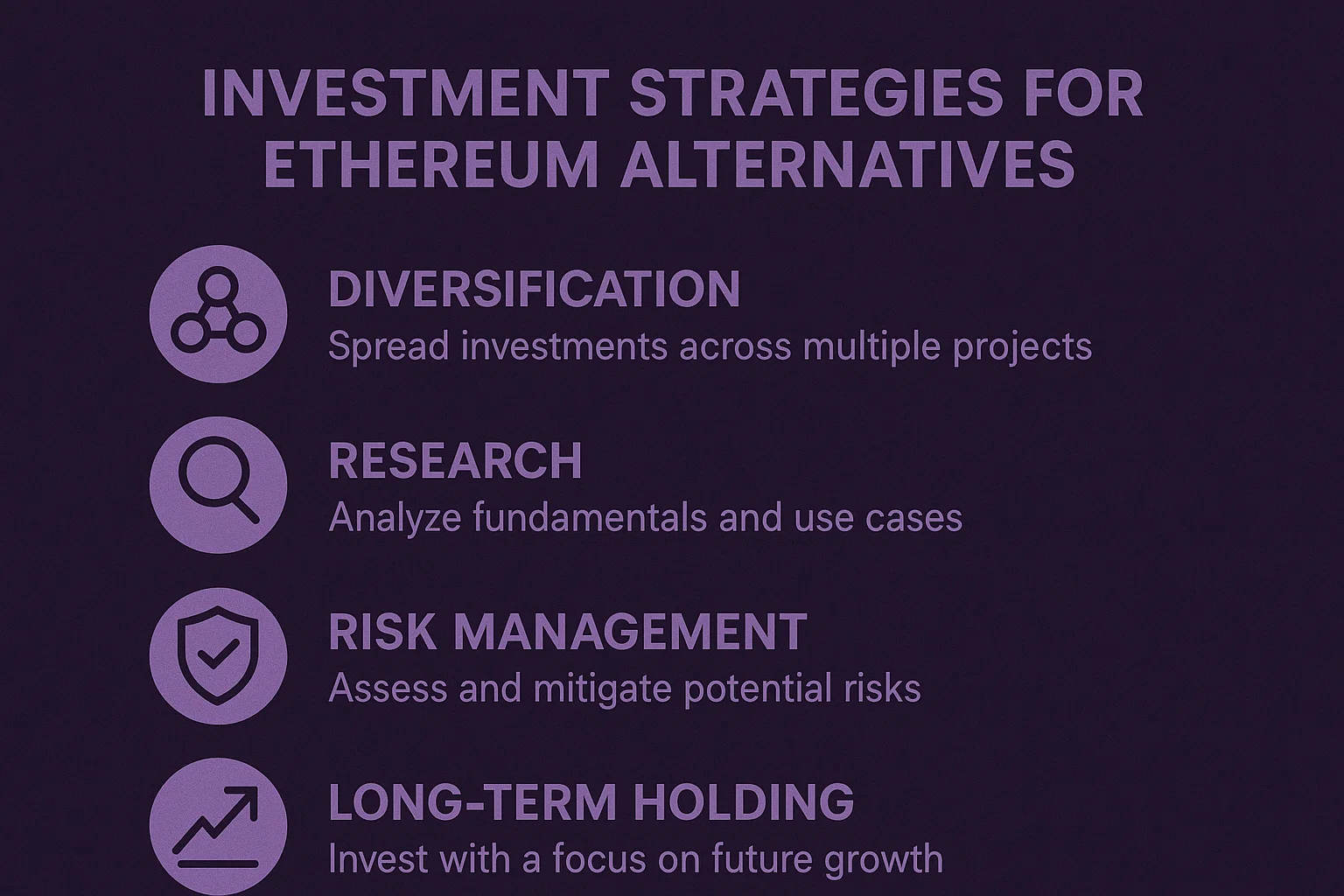
Rather than concentrating exposure in a single Ethereum alternative, sophisticated investors diversify across multiple promising platforms. This approach mitigates platform-specific risks while capturing upside from various technological approaches. A diversified portfolio might include established alternatives like Solana and Cardano alongside emerging platforms like Sui and Aptos.
Allocation strategies should reflect individual risk tolerance and investment timelines. Conservative investors might allocate larger portions to established alternative cryptocurrencies with proven track records, while aggressive investors might emphasize emerging platforms with higher growth potential. Regular rebalancing ensures portfolios remain aligned with investment goals as market conditions evolve.
Dollar-Cost Averaging Strategy
Market timing proves difficult even for experienced traders, making dollar-cost averaging an effective strategy for accumulating Ethereum alternatives. By investing fixed amounts at regular intervals, investors reduce exposure to short-term volatility while building positions over time. This disciplined approach eliminates emotional decision-making and often results in lower average acquisition costs.
Dollar-cost averaging works particularly well for crypto investments in promising but volatile assets. During sideways markets, this strategy allows accumulation at relatively stable prices, positioning investors to benefit when bullish momentum eventually returns. Combining dollar-cost averaging with fundamental analysis of blockchain alternatives creates a robust investment framework.
Staking and Yield Generation
Many Ethereum alternatives offer staking mechanisms that allow token holders to earn passive income while supporting network security. Staking rewards typically range from 5% to 20% annually, providing attractive returns while holding positions long-term. Platforms with robust staking infrastructure offer additional value beyond price appreciation potential.
DeFi protocols built on alternative cryptocurrencies also provide yield farming opportunities with potentially higher returns. However, these strategies carry additional risks, including smart contract vulnerabilities and impermanent loss. Investors should thoroughly research protocols and understand risks before committing capital to yield generation strategies.
Risks and Challenges of Investing in Ethereum Alternatives
Regulatory Uncertainty
Regulatory developments pose significant risks to all crypto investments, particularly alternatives to established cryptocurrencies. Governments worldwide are developing frameworks for cryptocurrency regulation, and adverse regulatory decisions could impact specific platforms disproportionately. Investors should monitor regulatory developments and maintain flexibility to adjust positions as the landscape evolves.
Platforms with strong compliance frameworks and transparent governance structures may fare better under increased scrutiny. When evaluating Ethereum alternatives, considering regulatory risk profiles alongside technical merits provides a more complete investment picture. Diversification across platforms with different regulatory exposures can help manage this uncertainty.
Technology and Competition Risks
The blockchain space evolves rapidly, with new technological innovations potentially rendering existing solutions obsolete. Ethereum alternatives face continuous competitive pressure from newer platforms offering superior features. Additionally, technological vulnerabilities or design flaws may only become apparent as platforms scale, creating unexpected risks for investors.
Ethereum itself continues to develop, with planned upgrades potentially addressing current limitations. If Ethereum successfully implements its roadmap, some alternative cryptocurrencies may lose their competitive advantages. Investors must remain vigilant, monitoring both their investments and competitive developments to make informed hold-or-sell decisions.
Market Volatility and Liquidity Concerns
Cryptocurrency markets remain highly volatile, with Ethereum alternatives often experiencing more dramatic price swings than established cryptocurrencies. This volatility creates opportunities but also substantial risks, particularly for leveraged positions or poorly-timed entries. Smaller-cap altcoins may also suffer from liquidity issues, making large positions difficult to exit without significant slippage.
During market downturns, alternative cryptocurrencies typically decline more severely than Bitcoin or Ethereum, requiring strong conviction and risk management. Investors should establish clear risk parameters, including position sizing limits and stop-loss levels, to protect capital during volatile periods.
The Future Outlook for Ethereum Alternatives
Multi-Chain Future and Interoperability
The cryptocurrency ecosystem appears headed toward a multi-chain future where numerous blockchains coexist and interoperate rather than a single platform dominating. This vision benefits Ethereum alternatives, as different platforms can specialize in specific use cases while maintaining connectivity through bridges and cross-chain protocols. Interoperability solutions like Cosmos IBC and Polkadot’s parachain model exemplify this emerging paradigm.
For investors, a multi-chain future suggests sustained demand for diverse blockchain alternatives, each serving different niches within the broader ecosystem. Platforms that embrace interoperability and establish strong cross-chain connections likely offer superior long-term value. Understanding positioning within this multi-chain landscape helps investors identify opportunities with the greatest appreciation potential.
Institutional Adoption Trends
Institutional interest in crypto investments continues growing, with many institutions exploring alternatives beyond Bitcoin and Ethereum. Platforms demonstrating enterprise readiness, regulatory compliance, and robust security attract institutional capital, driving price appreciation and ecosystem growth. Ethereum alternatives securing major institutional partnerships or treasury allocations often experience subsequent bull runs.
Monitoring institutional adoption metrics, including custody solutions, ETF applications, and corporate balance sheet allocations, provides early signals of emerging opportunities. Platforms gaining institutional traction typically transition from speculative assets to legitimate digital assets with reduced volatility and improved liquidity.
Technological Innovation and Evolution
Continuous technological innovation drives the blockchain space forward, with breakthroughs in zero-knowledge proofs, consensus mechanisms, and smart contract capabilities enabling new possibilities. Ethereum alternatives at the forefront of technological innovation position themselves for long-term success. Developments in quantum-resistant cryptography, privacy-preserving computation, and scalability solutions will likely determine which platforms thrive.
Investors should maintain awareness of technological trends and identify platforms making meaningful contributions to blockchain advancement. Smart contract platforms that solve real problems rather than simply replicating existing solutions offer superior investment prospects. The convergence of artificial intelligence and blockchain also presents emerging opportunities worth monitoring.
Conclusion
As Ethereum continues trading sideways, exploring Ethereum alternatives has become not just prudent but essential for investors seeking to maximize returns in the evolving cryptocurrency landscape. The platforms discussed in this article—from established alternatives like Solana, Cardano, and Polygon to emerging innovators like Sui and Aptos—each offer unique value propositions addressing Ethereum’s limitations. Success in crypto investments requires thorough research, disciplined risk management, and continuous learning as the ecosystem evolves.
The cryptocurrency market’s maturation means that opportunities extend far beyond the original pioneers. Ethereum alternatives represent not a rejection of Ethereum’s vision but rather an expansion of that vision across multiple specialized platforms. By diversifying across promising blockchain alternatives, implementing sound investment strategies, and remaining attentive to technological and market developments, investors can position themselves to benefit from the next phase of blockchain adoption.
Read More: Ethereum Price Falls Below $4,000 Reversal Signals Ahead