



This sharp decline has intensified concerns about miner sustainability, network security, and the broader health of the digital asset ecosystem. For miners already grappling with rising energy costs and increasing competition, the current environment is proving especially unforgiving. When daily Bitcoin mining revenue contracts this dramatically, it sends a powerful signal across the market. Mining revenue is one of the most important indicators of Bitcoin’s economic strength, directly tying together price performance, transaction fees, and network activity. As revenue shrinks, miners are forced to adapt quickly, often by selling more Bitcoin, shutting down inefficient machines, or exiting the industry altogether. Understanding why daily Bitcoin mining revenue has fallen to such a low level, and what it could mean next, is essential for investors, miners, and analysts navigating this volatile phase of the crypto market.
Daily Bitcoin Mining Revenue and the Current Market Shock
What Daily Bitcoin Mining Revenue Represents
Daily Bitcoin mining revenue refers to the total income miners earn from block rewards and transaction fees within a 24-hour period. This metric reflects not only Bitcoin’s market price but also network usage and competition among miners. When revenue is high, miners are incentivized to expand operations, strengthening the network. When it falls, pressure builds across the ecosystem. The recent drop to $28 million marks one of the weakest revenue days of the year, highlighting how sharply conditions have deteriorated. This decline has occurred alongside a broader crypto sell-off that has weighed heavily on Bitcoin’s price and reduced transaction fee income.
Why the $28 Million Figure Matters
A yearly low in daily Bitcoin mining revenue is more than just a headline number. It represents shrinking margins for miners and signals potential instability if the trend persists. Historically, prolonged periods of low mining revenue have preceded miner capitulation events, where weaker players are forced out of the market. This moment is particularly significant because it follows months of already compressed profitability, leaving little room for error.
How the Crypto Sell-Off Crushed Daily Bitcoin Mining Revenue
Bitcoin Price Decline and Revenue Compression
Bitcoin’s price is the single biggest driver of daily Bitcoin mining revenue. As the market sells off, the fiat value of block rewards drops instantly. Even if miners produce the same number of coins, their real-world income shrinks. The recent sell-off has pushed Bitcoin well below key resistance levels, eroding mining revenue faster than miners can adjust costs. This has been compounded by subdued market sentiment, which has kept transaction fees unusually low.
Falling Transaction Fees Add to the Pain
Transaction fees are the second major component of daily Bitcoin mining revenue. During periods of high network activity, fees can significantly boost miner income. However, during the current downturn, on-chain activity has slowed, and users are paying fewer fees. This double hit—lower BTC prices and weaker fee income—has accelerated the revenue collapse and left miners exposed.
Daily Bitcoin Mining Revenue and Miner Profitability
Rising Costs in a Declining Revenue Environment
While daily Bitcoin mining revenue has fallen, mining costs have not followed the same trajectory. Electricity prices remain elevated in many regions, and hardware maintenance costs continue to rise. This imbalance is squeezing profit margins across the industry. Miners operating with older, less efficient equipment are feeling the pressure most acutely. For many, current revenue levels barely cover operating expenses, let alone allow for expansion or reinvestment.
Miner Profitability at Risk
When daily Bitcoin mining revenue reaches a yearly low, miner profitability often turns negative for a portion of the network. This creates a survival-of-the-fittest environment where only the most efficient operations can endure. As profitability declines, miners may be forced to liquidate Bitcoin reserves to cover costs, increasing selling pressure and reinforcing bearish market conditions.
Historical Context: What Happens When Daily Bitcoin Mining Revenue Falls
Looking back at previous cycles, sharp declines in daily Bitcoin mining revenue have often coincided with late-stage bear markets. In several instances, these periods were followed by miner capitulation, difficulty adjustments, and eventual market stabilization. While each cycle is unique, the pattern suggests that low mining revenue tends to occur when pessimism is widespread and prices are under sustained pressure. For long-term observers, this context helps frame the current downturn as part of Bitcoin’s broader market rhythm rather than an existential crisis.
Daily Bitcoin Mining Revenue and Network Security
Hash Rate Resilience Under Pressure
One concern when daily Bitcoin mining revenue drops sharply is the potential impact on network security. Lower revenue can lead some miners to shut down, reducing the total hash rate securing the Bitcoin blockchain.
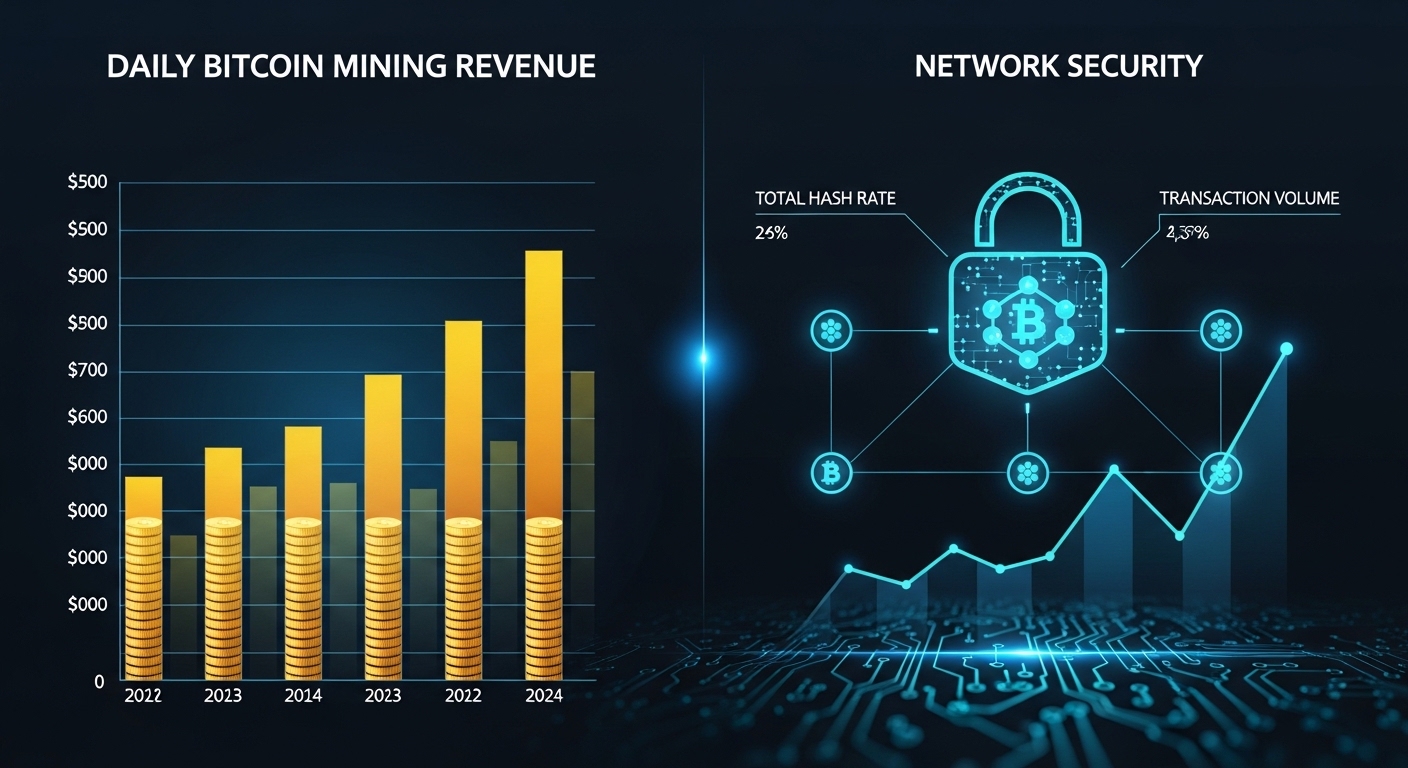
So far, the network has shown relative resilience. While growth in hash rate has slowed, it has not collapsed, indicating that many miners are still willing to operate despite reduced profitability.
Difficulty Adjustments as a Safety Valve
Bitcoin’s built-in difficulty adjustment mechanism plays a crucial role during periods of low daily Bitcoin mining revenue. As miners exit the network, difficulty adjusts downward, making it easier and cheaper for remaining miners to produce blocks. This self-correcting system helps stabilize the network over time, even during extended periods of economic stress.
Investor Sentiment and Daily Bitcoin Mining Revenue
Market sentiment often deteriorates alongside falling daily Bitcoin mining revenue. Headlines highlighting revenue lows tend to amplify fear, particularly among retail investors. However, institutional players often interpret the same data differently. For long-term investors, low mining revenue can signal potential undervaluation, especially if network fundamentals remain intact. This divergence in perception contributes to heightened volatility during downturns. Understanding sentiment dynamics is critical when interpreting what declining mining revenue actually means for Bitcoin’s future price trajectory.
Daily Bitcoin Mining Revenue and Miner Capitulation Risk
What Miner Capitulation Looks Like
Miner capitulation occurs when sustained low daily Bitcoin mining revenue forces miners to shut down operations and sell accumulated BTC. This process can temporarily flood the market with supply, pushing prices lower in the short term. However, capitulation also removes inefficient miners, allowing healthier operations to regain profitability once conditions improve.
Are We Approaching Capitulation?
The current yearly low in daily Bitcoin mining revenue suggests that capitulation risk is rising, though it has not fully materialized yet. Monitoring miner outflows to exchanges and changes in hash rate can provide early warning signs of deeper stress.
Broader Market Implications of Falling Mining Revenue
Impact on Bitcoin Price Stability
When daily Bitcoin mining revenue falls, the ripple effects extend beyond miners. Increased selling pressure can weigh on prices, while reduced miner investment can slow infrastructure development. At the same time, these periods often mark phases where speculative excess has been flushed from the market, potentially setting the stage for healthier growth later on.
Relationship With Macro Conditions
Macroeconomic factors such as interest rates, inflation expectations, and global risk sentiment also influence daily Bitcoin mining revenue indirectly. Tight financial conditions reduce speculative demand, dampening prices and on-chain activity. As long as macro uncertainty persists, mining revenue may remain under pressure.
Conclusion
While falling mining revenue can amplify short-term volatility, it has historically played a role in resetting the market and strengthening Bitcoin’s long-term foundation. Understanding why daily Bitcoin mining revenue matters—and how it interacts with price, hash rate, and sentiment—can help market participants navigate uncertainty with greater confidence.
See more: Bitcoin Value Service Model – Bitwise Expert Analysis 2024