


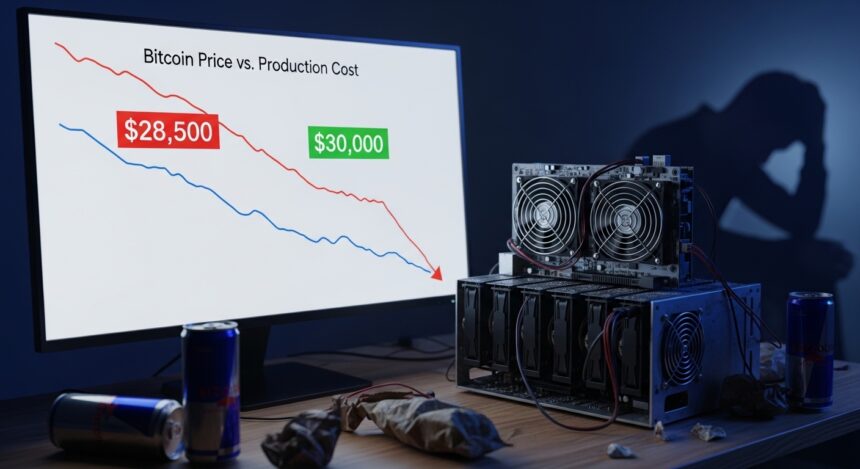
This rare market condition has historically marked pivotal moments in Bitcoin’s price cycle, making it a critical topic for traders, miners, and long-term holders alike. When Bitcoin’s market price falls significantly below the average cost required to mine a single BTC, it puts immense pressure on miners to stay afloat. At the same time, it raises broader questions about whether the market is undervaluing the asset or bracing for further downside. Understanding what it means when Bitcoin trades below production cost can help investors interpret on-chain signals, assess risk, and identify potential long-term opportunities hidden beneath short-term fear. In this article, we’ll explore why Bitcoin’s production cost matters, how declining miner profitability impacts the market, and what history suggests could happen next.
What It Means When Bitcoin Trades Below Production Cost
When analysts say Bitcoin trades below production cost, they are referring to a situation where the market price of Bitcoin falls under the average expense required to mine one BTC. This production cost typically includes electricity prices, mining hardware efficiency, operational expenses, and network difficulty. Bitcoin mining is not a fixed-cost business. As hash rate increases and mining difficulty adjusts, the cost of producing new Bitcoin rises. When the market price drops faster than miners can adapt, profitability shrinks rapidly. This is exactly what we are seeing now, with Bitcoin mining profitability reaching a 14-month low. Historically, these moments often coincide with late-stage bear markets or deep corrections. While not a perfect indicator, the production cost has acted as a rough “floor” for Bitcoin prices over the long term.
Bitcoin Trades Below Production Cost and Miner Capitulation
Why Miner Profitability Matters
Miner profitability is a crucial on-chain metric because miners are natural sellers. They need to sell a portion of their mined Bitcoin to cover operational costs. When Bitcoin trades below production cost, miners face a tough choice: sell at a loss or shut down operations. This stress can lead to what analysts call miner capitulation, a phase where less efficient miners exit the network entirely. During these periods, hash rate may temporarily decline, and selling pressure can increase as miners liquidate BTC to stay solvent.
The 14-Month Low Explained
The current drop in miner profitability to a 14-month low suggests that many mining operations are operating on razor-thin margins. Rising energy costs and stagnant Bitcoin prices have intensified the squeeze, especially for miners using older hardware. While this scenario sounds bearish on the surface, it has historically preceded periods of market stabilization and recovery once weak hands are flushed out.
Historical Patterns When Bitcoin Trades Below Production Cost
Looking back at previous market cycles, periods when Bitcoin trades below production cost have often aligned with major accumulation zones. In 2018, 2020, and briefly in 2022, Bitcoin dipped below its estimated mining cost, only to rebound strongly in subsequent months. These moments tend to occur when market sentiment is deeply pessimistic. Fear dominates headlines, trading volume slows, and long-term investors quietly accumulate while short-term participants exit. It’s important to note that while history doesn’t repeat perfectly, it often rhymes. The production cost metric has consistently acted as a long-term valuation anchor rather than a precise short-term trading signal.
Bitcoin Mining Economics in the Current Market
Rising Hash Rate vs Falling Price
One of the more interesting dynamics right now is that despite Bitcoin trading below production cost, the network hash rate remains relatively strong. This indicates that many miners are betting on future price appreciation rather than immediate profitability. However, this resilience may not last indefinitely. If prices remain suppressed, even well-capitalized miners may be forced to reduce operations or sell reserves, adding further pressure to the market.
Impact of Mining Difficulty Adjustments
Bitcoin’s difficulty adjustment mechanism helps rebalance the network over time. As inefficient miners drop out, difficulty adjusts downward, reducing production costs for remaining miners. This self-correcting feature is one reason why prolonged periods where Bitcoin trades below production cost are relatively rare. Over time, this mechanism helps restore equilibrium between price and mining economics.
Bitcoin Trades Below Production Cost and Market Sentiment
Market sentiment plays a huge role in amplifying the effects of declining miner profitability. When headlines highlight that Bitcoin trades below production cost, fear tends to spread quickly across social media and news platforms.

Retail investors often interpret this signal as a sign of weakness, while institutional investors may see it as a potential long-term value opportunity. This divergence in perception is what creates the intense volatility often seen during these phases. Sentiment indicators such as the Crypto Fear and Greed Index typically register extreme fear during periods when production costs exceed market prices.
Investor Implications When Bitcoin Trades Below Production Cost
For long-term investors, understanding why Bitcoin trades below production cost can provide valuable context. While it does not guarantee a price bottom, it does suggest that the asset may be undervalued relative to its network fundamentals. For short-term traders, however, these periods can be risky. Increased miner selling, reduced liquidity, and heightened volatility can lead to sharp price swings in both directions. Risk management becomes essential, as market conditions can remain irrational longer than expected.
Bitcoin Price Outlook Amid Declining Miner Profitability
Predicting short-term price movements is notoriously difficult, especially when macroeconomic factors such as interest rates, inflation, and global risk appetite are in flux. However, when Bitcoin trades below production cost, it often signals that much of the bad news is already priced in. If miner capitulation accelerates, a temporary price dip could occur. But once selling pressure subsides and difficulty adjusts, the market often finds stability. Long-term fundamentals such as Bitcoin’s fixed supply, growing institutional interest, and increasing adoption remain unchanged despite short-term mining stress.
Key On-Chain Metrics to Watch Right Now
Several on-chain indicators become especially important during periods when Bitcoin trades below production cost. Metrics such as miner reserves, hash rate trends, and exchange inflows can provide clues about whether miners are accumulating or distributing BTC. A stabilization or increase in miner reserves may indicate that the worst of the selling pressure is over. Conversely, sharp declines could signal further downside risk. These data points, when combined with production cost analysis, offer a more complete picture of market health.
Conclusion
Periods when Bitcoin trades below production cost are uncomfortable, emotional, and often misunderstood. Yet historically, they have marked critical transition points in Bitcoin’s market cycle. While short-term volatility and miner stress can weigh on prices, these phases often lay the groundwork for longer-term recovery. For investors willing to zoom out, understanding mining economics and on-chain data can turn fear into informed decision-making. Whether you’re a miner navigating shrinking margins or an investor evaluating long-term value, keeping a close eye on when Bitcoin trades below production cost may provide insights that others overlook.
See more: Bitcoin Price Slides to $104K as Market Fear Hits Extreme