


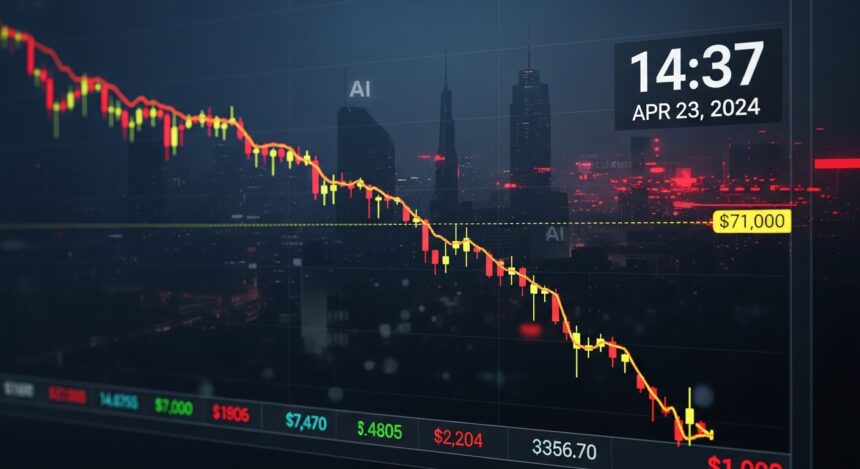
The drop below the psychological $71,000 mark has left many wondering: Is this the beginning of a more extended correction, or will Bitcoin quickly rebound? In this article, we’ll explore the factors behind the sudden drop, the ongoing struggles in the tech sector, and the potential for Bitcoin’s price trajectory moving forward.
The AI-Driven Tech Rout and Its Impact on Bitcoin
Why the AI-Driven Tech Rout Is Affecting Bitcoin
The AI-driven tech rout has created a ripple effect across various asset classes, including cryptocurrencies. Investors who were initially pouring money into AI companies, driven by the promise of cutting-edge technologies, are now pulling back, fearing that valuations have become unsustainable. As tech stocks, particularly those in the AI space, begin to experience significant losses, the Bitcoin market is also feeling the weight. Historically, Bitcoin has been somewhat insulated from traditional market trends. However, as the cryptocurrency market matures, it has increasingly correlated with tech stocks, especially when global market sentiment turns negative. The panic selling that’s gripping the tech sector has spilled over into digital assets, driving Bitcoin below $71,000.
The Role of Overinflated Tech Valuations
Much of the pain in the tech sector can be attributed to overinflated valuations, particularly in AI stocks that have seen astronomical growth over the past year. As companies continue to announce AI-driven solutions, the market has become overly optimistic, leading to a rapid price surge. However, as is often the case with speculative bubbles, the market is now correcting, and investors are reassessing their positions. Bitcoin, as a major part of the broader crypto ecosystem, is often affected by shifts in market sentiment towards tech and speculative assets. When AI stocks begin to fall, risk appetite across the board decreases, triggering sell-offs not only in tech but also in cryptocurrencies. This correlation has intensified as more institutional investors have entered the crypto space, making Bitcoin more susceptible to swings in tech-heavy indices.
Bitcoin’s Struggles Amid the Market Decline
How Investor Sentiment is Shaping Bitcoin’s Price
One of the primary drivers behind Bitcoin slipping below $71,000 is a sharp decline in investor sentiment. As the broader market enters a period of heightened uncertainty, risk-averse investors begin to liquidate their positions. Bitcoin, which has been seen as a risky but lucrative investment, is not immune to these sell-offs. In times of market turmoil, even long-term holders may start to reconsider their positions, fearing further losses. Moreover, as AI-driven tech stocks take a hit, investors are more likely to look for safer assets, such as bonds or gold. This shift in asset allocation further dampens demand for riskier assets like Bitcoin, contributing to the slip below $71,000. The overall bearish sentiment in both the tech and crypto sectors signals that the market might be entering a more extended period of volatility.
Impact of Rising Interest Rates
Another factor contributing to Bitcoin’s price decline is the rise in interest rates globally. With central banks, particularly the U.S. Federal Reserve, continuing to raise rates to combat inflation, many investors are turning to traditional fixed-income investments that offer safer, more stable returns. The shift from high-risk assets to safer investments has created downward pressure on Bitcoin and other cryptocurrencies, which are seen as more volatile. Bitcoin’s sensitivity to macroeconomic factors like interest rates underscores its vulnerability to broader financial conditions. When interest rates increase, the cost of capital rises, and speculative investments, including Bitcoin, become less attractive. As a result, the cryptocurrency market faces more pressure, and Bitcoin slips below $71,000 as traders reassess their risk exposure.
What’s Driving the Bitcoin Recovery?
Potential for Rebound as Sentiment Shifts
Despite the current challenges, there are several factors that could drive Bitcoin’s recovery in the coming months. First, the fundamental value of Bitcoin remains intact. The token’s limited supply and decentralized nature make it an attractive hedge against inflation and economic instability in the long run. Moreover, Bitcoin’s increasing institutional adoption continues to provide a strong foundation for future growth. While short-term market fluctuations can cause significant volatility, institutional investors tend to focus on the long-term potential of Bitcoin. Their continued involvement in the market could help stabilize prices as Bitcoin below $71,000 levels begin to attract long-term buyers.
The Influence of Regulatory Clarity
Another positive development for Bitcoin is the potential for clearer regulatory frameworks around cryptocurrencies. As governments and regulators around the world begin to implement clearer policies, institutional investors may gain more confidence in the market. Regulatory clarity could drive new investment into Bitcoin and other digital assets, helping to mitigate the effects of short-term market volatility.

While regulatory uncertainty has been a significant challenge for the crypto market, the growing acceptance of digital assets in mainstream finance suggests that the regulatory environment will continue to evolve in a favorable direction. If this trend continues, it could provide the support needed for Bitcoin’s price to recover and even surpass previous highs.
How AI and Blockchain Can Coexist in the Tech Sector
The Growing Integration of AI and Blockchain
While the AI-driven tech rout has hurt Bitcoin in the short term, it’s essential to recognize the growing synergy between AI and blockchain technology. Many leading blockchain projects, including those surrounding Bitcoin, are incorporating AI technologies to improve scalability, security, and efficiency. As AI continues to evolve, its integration with blockchain networks will drive further innovation, potentially offering a long-term bullish outlook for digital assets. This convergence of AI and blockchain technology could lead to new use cases for Bitcoin and other cryptocurrencies. For instance, AI-powered smart contracts, decentralized applications (dApps), and enhanced network security could offer a new dimension to the blockchain ecosystem, potentially driving demand for Bitcoin and other digital currencies once the current market volatility settles down.
A Growing Market for AI-Backed Blockchain Projects
Several blockchain projects have already begun to leverage AI for advanced data analytics, smart contract execution, and predictive modeling. This fusion of technologies could help alleviate some of the volatility seen in both markets. As the use cases for AI and blockchain grow, it could result in an eventual rise in investor confidence, thereby boosting Bitcoin’s value in the long run.
While Bitcoin slipping below $71,000 may seem like a significant downturn, it is essential to remember that the integration of AI and blockchain technology is still in its early stages. The potential of this convergence could result in substantial growth for Bitcoin, driving its price back up once the AI-driven tech rout subsides.
What’s Next for Bitcoin?
Will Bitcoin Surpass $71,000 Again?
The million-dollar question on every investor’s mind is: Will Bitcoin surpass $71,000 again? Given the current market dynamics, the answer is not straightforward. If Bitcoin can maintain its institutional adoption momentum and ride the wave of increasing regulatory clarity, it has a solid foundation to recover. However, the road ahead may not be easy, and it could take some time before Bitcoin sees a full recovery. The price of Bitcoin will likely continue to be influenced by macroeconomic factors, the performance of the broader tech sector, and its integration with emerging technologies like AI. As market conditions stabilize, Bitcoin’s price could climb back above $71,000 and beyond.
Conclusion
The current market conditions have led to a Bitcoin slip below $71,000, driven by the ongoing AI-driven tech rout and broader economic factors like rising interest rates. While the short-term outlook may appear bleak, Bitcoin’s long-term prospects remain strong, thanks to its unique value proposition and growing institutional adoption. For those considering entering the market or holding their positions, it’s essential to keep a close eye on both the tech sector’s recovery and the broader macroeconomic environment. As investor sentiment shifts and regulatory clarity increases, Bitcoin could quickly rebound, surpassing the $71,000 mark once again.
See more: Crypto Market Shed $220B This Week as Bitcoin Slips Hard