


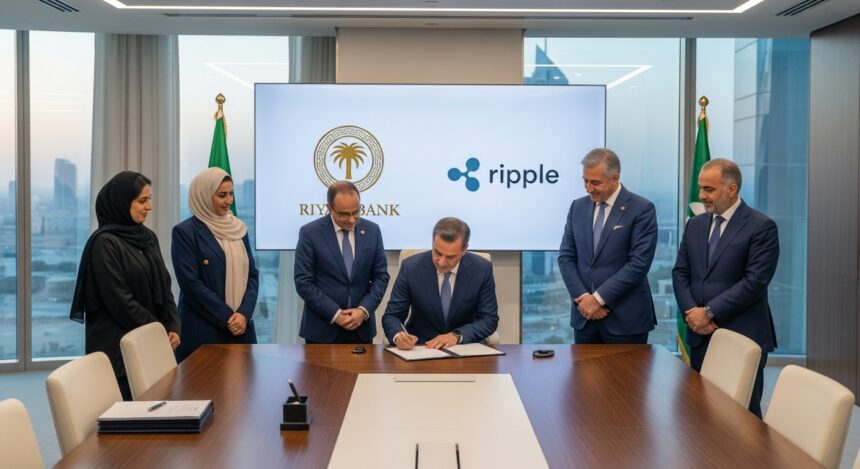
As the Kingdom accelerates its digital transformation agenda, this strategic memorandum of understanding brings together Riyad Bank’s innovation arm, Jeel, and global blockchain technology firm Ripple to explore advanced blockchain applications within the Saudi financial ecosystem. The collaboration reflects a growing commitment by leading financial institutions to embrace distributed ledger technology as a foundation for next-generation banking services.
Within the first phase of cooperation, the Riyad Bank’s Joel and Ripple MoU sets the stage for researching and testing blockchain-powered solutions that enhance payment efficiency, transparency, and operational resilience. By aligning global blockchain expertise with local regulatory frameworks, the partnership underscores Saudi Arabia’s ambition to position itself as a regional hub for fintech innovation while supporting the broader objectives of Vision 2030.
Saudi Arabia’s Push Toward Blockchain-Driven Financial Innovation
Saudi Arabia has emerged as one of the Middle East’s most dynamic fintech markets, driven by proactive regulatory reforms and strong institutional backing. The Riyad Bank’s Jeel and Ripple MoU fits squarely within this national push to modernize financial infrastructure using advanced digital technologies.

Blockchain adoption in Saudi Arabia is increasingly viewed as a strategic enabler for faster payments, reduced operational costs, and improved financial transparency. With cross-border transactions forming a critical component of the Kingdom’s trade-oriented economy, blockchain solutions offer an attractive alternative to traditional payment rails that are often slow and costly. By signing this MoU, Riyad Bank and Ripple signal their intent to jointly explore how blockchain technology can be adapted to meet local banking needs while complying with Saudi regulatory requirements.
Riyad Bank’s Jewel and Ripple MoU Explained
The Riyad Bank’s Jewel and Ripple MoU establishes a framework for collaboration focused on evaluating blockchain use cases across banking and financial services in Saudi Arabia. Rather than an immediate commercial deployment, the agreement emphasizes research, experimentation, and knowledge exchange.
Jewel, as Riyad Bank’s digital innovation and venture arm, serves as the primary conduit for integrating emerging technologies into the bank’s strategic roadmap. Ripple contributes its enterprise-grade blockchain expertise, particularly in areas such as real-time payments, settlement infrastructure, and distributed ledger interoperability.
Through this MoU, both parties aim to identify viable blockchain applications that align with Saudi Arabia’s financial regulations and long-term economic objectives.
The Strategic Role of Jewel in Digital Transformation
Joel plays a central role in translating the ambitions of the Riyad Bank’s Joel and Ripple MoU into actionable innovation initiatives. Established to drive Riyad Bank’s digital future, Joel focuses on partnerships, investments, and pilot projects that accelerate fintech adoption.
By collaborating with Ripple, Joel gains access to global insights into blockchain implementation while maintaining a localized approach tailored to the Saudi market. This balance between global technology leadership and regional relevance is critical for ensuring sustainable innovation.
The partnership also strengthens Jewel’s position as a catalyst for fintech collaboration, enabling Riyad Bank to remain competitive in an increasingly digital banking environment.
Ripple’s Blockchain Expertise and Its Relevance to Saudi Banking
Ripple has built a global reputation for developing blockchain solutions designed specifically for financial institutions. Within the scope of the Riyad Bank’s Jeel and Ripple MoU, Ripple’s technology is being explored for its potential to enhance payment speed, reduce settlement friction, and improve liquidity management.
Unlike public blockchains aimed at retail users, Ripple’s infrastructure is optimized for enterprise use cases, offering scalability and compliance features that appeal to regulated banks. This makes Ripple a suitable partner for Saudi financial institutions operating under strict regulatory oversight.
The MoU enables Ripple to deepen its presence in the Middle East while contributing to Saudi Arabia’s vision of a digitally advanced financial sector.
Blockchain Applications in Saudi Arabia’s Banking Sector
The Riyad Bank’s Jeel and Ripple MoU highlights the growing relevance of blockchain applications in Saudi Arabia’s banking sector. Financial institutions across the Kingdom are exploring distributed ledger technology to modernize core processes and improve customer experience.
Blockchain applications extend beyond payments to areas such as trade finance, identity verification, compliance automation, and asset tokenization. For Saudi banks, these innovations promise greater efficiency and transparency while supporting economic diversification. By exploring these applications through a structured MoU, Riyad Bank ensures that blockchain adoption is aligned with national priorities and regulatory expectations.
Regulatory Alignment and the Importance of Compliance
Regulatory clarity is essential for blockchain adoption in any financial system. The Riyad Bank’s Jeel and Ripple MoU places strong emphasis on ensuring that all exploratory initiatives comply with Saudi banking laws and supervisory guidelines.
Saudi regulators have adopted a measured approach to fintech innovation, encouraging experimentation while safeguarding financial stability. This regulatory environment allows banks to test emerging technologies responsibly, reducing risk while accelerating learning. The MoU framework supports open dialogue between innovators and regulators, helping shape future policies around blockchain applications in Saudi Arabia.
Cross-Border Payments as a Core Focus Area
One of the most compelling use cases under the Riyad Bank’s Jeel and Ripple MoU is cross-border payments. Saudi Arabia’s role as a global trade and energy hub necessitates efficient international transaction capabilities. Blockchain-based payment systems can significantly reduce transaction times and costs by eliminating multiple intermediaries. Faster settlement also improves cash flow management for businesses and reduces counterparty risk. Exploring these capabilities aligns with Saudi Arabia’s broader goal of enhancing its global financial connectivity.
Supporting Vision 2030 Through Fintech Innovation
Saudi Arabia’s Vision 2030 outlines a comprehensive roadmap for economic transformation, with digital finance playing a critical role. The Riyad Bank’s Jeel and Ripple MoU directly supports this vision by fostering innovation in financial services.
Blockchain technology can enable more inclusive financial systems, empower small and medium-sized enterprises, and attract foreign investment. By proactively exploring blockchain applications, Riyad Bank positions itself as a contributor to national development goals. The MoU also sends a strong signal to global fintech firms that Saudi Arabia is open to strategic partnerships that drive long-term value.
Competitive Implications for the Middle East Banking Landscape
The Middle East’s banking sector is becoming increasingly competitive as digital transformation accelerates. The Riyad Bank’s Jeel and Ripple MoU gives Riyad Bank a strategic advantage by enabling early exploration of blockchain technologies.
Banks that successfully integrate blockchain solutions can offer faster services, enhanced transparency, and improved operational efficiency. These advantages are likely to shape customer expectations in the coming years. As regional peers observe the outcomes of this MoU, similar collaborations may follow, accelerating blockchain adoption across the Middle East.
Riyad Bank’s Jeel and Ripple MoU and Financial Inclusion
Beyond efficiency gains, the Riyad Bank’s Jeel and Ripple MoU has the potential to support financial inclusion in Saudi Arabia. Blockchain-enabled systems can lower transaction costs and expand access to digital financial services.
Small businesses and startups, which are central to Vision 2030, stand to benefit from faster and more affordable payment infrastructure. Improved access to financial services can stimulate entrepreneurship and job creation. By exploring inclusive blockchain applications, Riyad Bank reinforces its commitment to serving a diverse and evolving customer base.
Security, Transparency, and Trust in Blockchain Systems
Trust is fundamental to any financial system, and the Riyad Bank’s Jeel and Ripple MoU prioritizes security and transparency in blockchain exploration. Distributed ledger technology offers immutable transaction records, enhancing auditability and fraud prevention.
However, integrating blockchain into existing banking systems requires careful attention to cybersecurity and data protection. The MoU provides a controlled framework for evaluating these considerations before any large-scale deployment. This cautious approach ensures that innovation does not compromise the integrity of the Saudi financial system.
Lessons for Global Financial Institutions
The Riyad Bank’s Jeel and Ripple MoU offers valuable insights for banks worldwide seeking to navigate digital transformation. It demonstrates how traditional financial institutions can collaborate with technology providers while maintaining regulatory alignment. By prioritizing experimentation and learning, the partnership reduces uncertainty and builds institutional confidence in blockchain technology. This model may inspire similar initiatives in other emerging and developed markets.
The Future of Blockchain in Saudi Arabia’s Financial Ecosystem
As blockchain technology matures, initiatives like the Riyad Bank’s Jeel and Ripple MoU are likely to play a decisive role in shaping Saudi Arabia’s financial future. Continued exploration could lead to pilot programs, commercial deployments, and industry-wide adoption.
Potential future applications include tokenized assets, smart contracts for trade finance, and real-time settlement networks. Each of these innovations could strengthen Saudi Arabia’s position as a global financial hub. The success of this MoU will therefore be closely watched by regulators, banks, and fintech innovators alike.
Conclusion
The Riyad Bank’s Joel and Ripple MoU represents a forward-looking step toward integrating blockchain technology into Saudi Arabia’s banking sector. By combining institutional leadership, technological expertise, and regulatory awareness, the partnership lays the groundwork for sustainable financial innovation.
As the Kingdom advances its Vision 2030 agenda, blockchain exploration initiatives like this will be instrumental in modernizing financial infrastructure and enhancing global competitiveness. Now is the time for stakeholders to follow developments closely and engage with opportunities emerging from the Riyad Bank’s Joel and Ripple MoU to stay ahead in the evolving digital finance landscape.